
Defining an Option in DCM
The notions of futures and options (call options and put options) are core concepts in derivative trading, yet they resist formal definition.
Here, we demonstrate how these notions can be formalized, and thereby made executable (clearable), in the same way as the TRADE frame in the trade-settlement example.
Note that in the case of an option (CALL_OPTION or PUT_OPTION frames), there are threelevels of embedding (4 levels of framing) involved in the construction:
the frame construing an option (PUT_OPTION or CALL_OPTION) consists of a FUTURE_TRADE component;
the FUTURE_TRADE component is itself a composite frame, FUTURE, which in turn consists of a DELIVERY component;
the DELIVERY component is itself a composite frame, TRADE, which in turn consists of two TRANSFER components.
Note that, overall, the option frame contains four TRANSFER fibres, all at different levels of embedding.
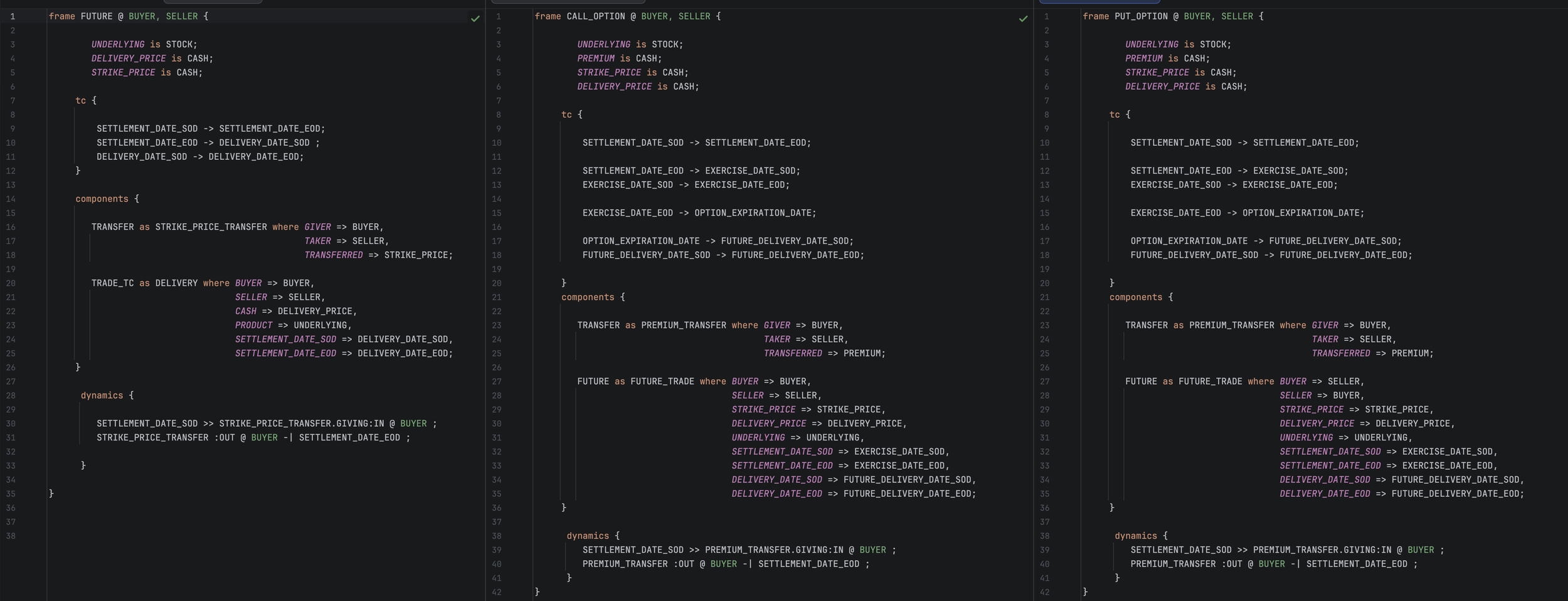
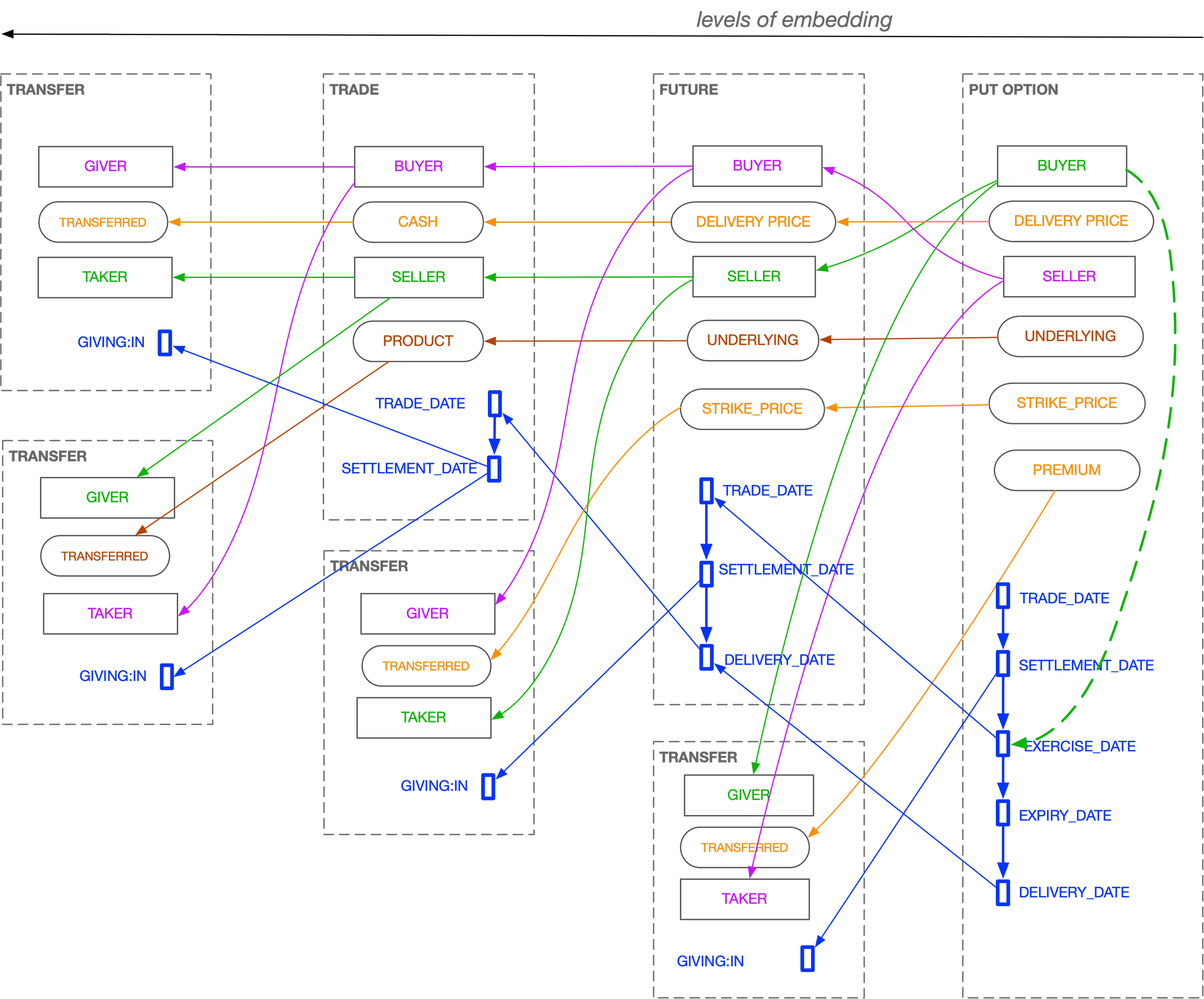
It’s important to note that the perceived complexity of (understanding) the notion of an option—particularly for a novice—stems from the presence of multiple levels of embedding, as well as from the repeated appearance of the same component frame, TRANSFER (representing transfer of cash), and the same role names (BUYER and SELLER) at different levels of embedding.
In DCM, the PUT OPTION is a frame with a deep composition path, much like a Russian doll, comprising at least four levels (excluding levels that merely elaborate a frame without composing several different frames into one).
Importantly, each level remains visible and maintains its own independent existence (as a fibre) within the target construal modelling the option. This ensures that the internal structure of the option remains amenable to modifications at any of these four levels.
Thus, for example, if we are only concerned with the movement of cash for the sake of regulatory or client reporting, we can implement the solution at the level of the TRANSFER frame, where the figure has nominal construal of cash. This solution will work across all types of contracts (frames) that are defined—including stock trades, futures, options, borrowing and lending—without even needing to know which ones are present.
In this sense, structures (frames) built within DCM are transparent and open to access and modification along many dimensions—through multiple POVs represented by different frames—simultaneously.