
Deep Cognitive Models
DCM aims to model the financial world in the way the human mind understands it.
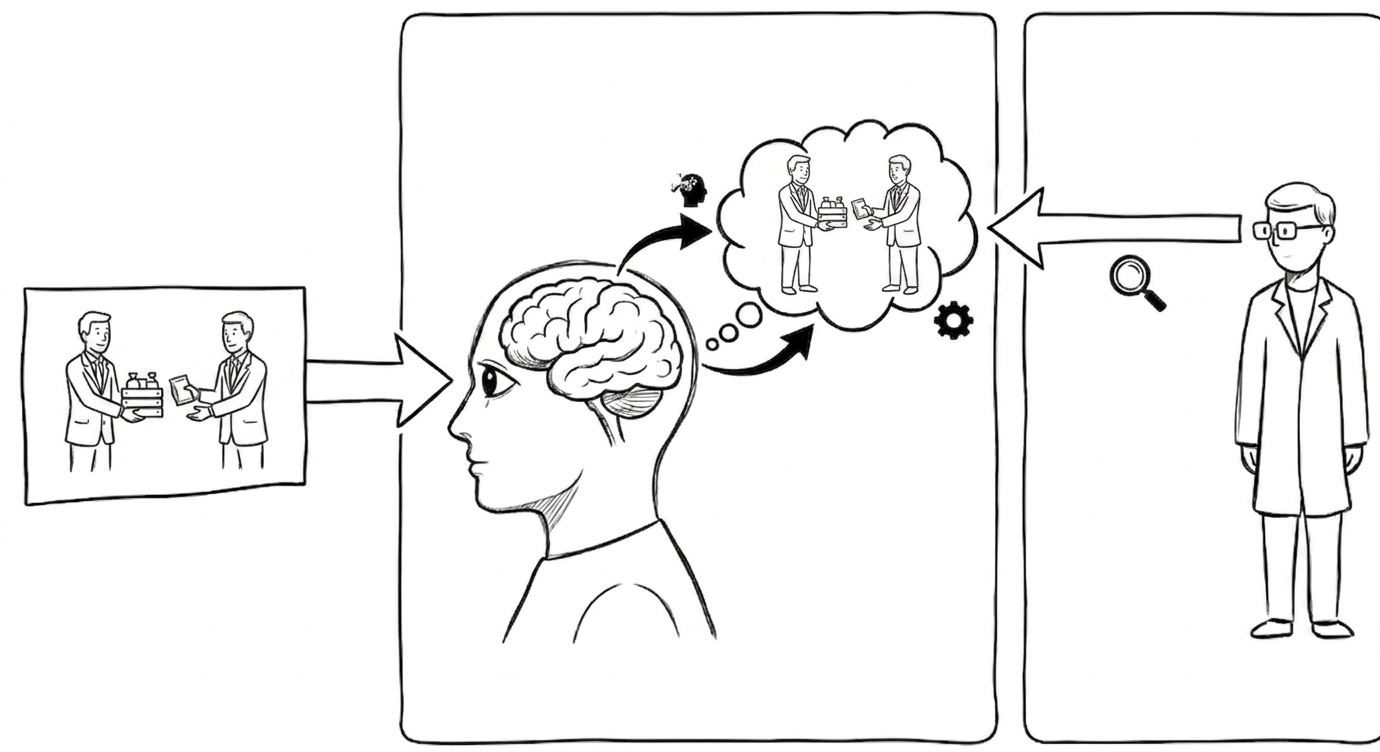
Working in DCM means building a world model—a financial world model—that is online, executable, and capable of directly driving the business. It is not an offline simulation; it automates real operations—anything grounded in the notion of a contract, from order processing and trade settlement to corporate actions and all the steps in between.
The DCM approach keeps deterministic reasoning in the driver’s seat while confining LLMs to constrained assistant roles. This delivers the best of both worlds: removing hallucinations, controlled complexity, and prevention of accumulated error, noise, and cognitive or technical debt.
Why can’t LLMs do it all?
Deterministic → predictable and reliable
Direct and total control over every detail
Transparent, explainable, human-readable reasoning
Scales cleanly with system size and long-term evolution
No hidden drift, noise accumulation, or reasoning opacity
D
C
M
Statistical → inherently unpredictable
Indirect and very loose control through prompts and generated code
Black-box behavior with post-hoc explanations
Accumulates noise and inconsistencies over time
Degrades as complexity and iteration count increase
L
L
M
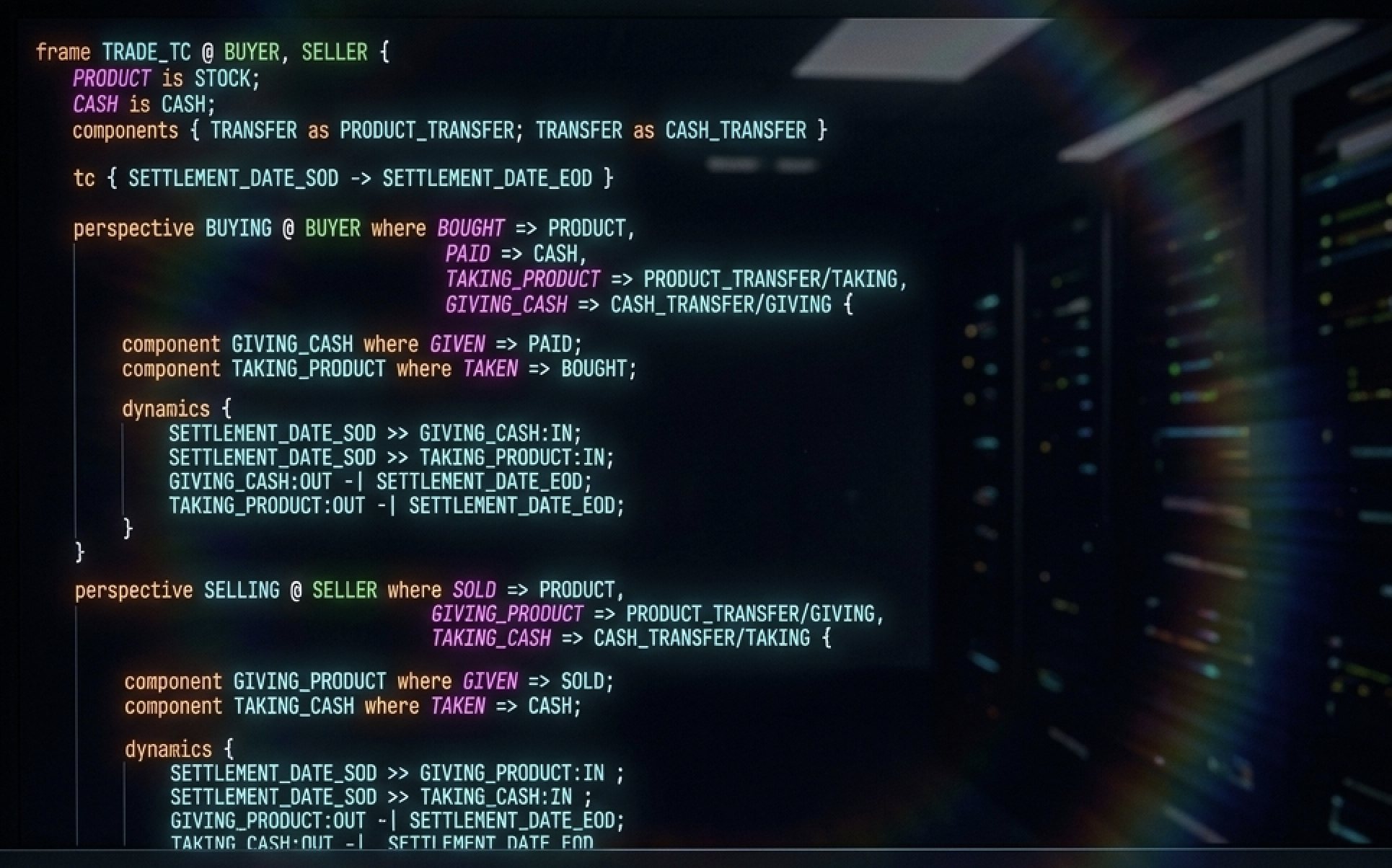
Unlike models that attempt to capture the real world objectively, DCM models how the world appears to an observer or cognizer.
As such, the model incorporates features of the cognizer no less than it incorporates features of the physical world in which the cognizer is embedded.
In this sense it is a model of subjectivity.
Conceptual reasoning ≠ code generation
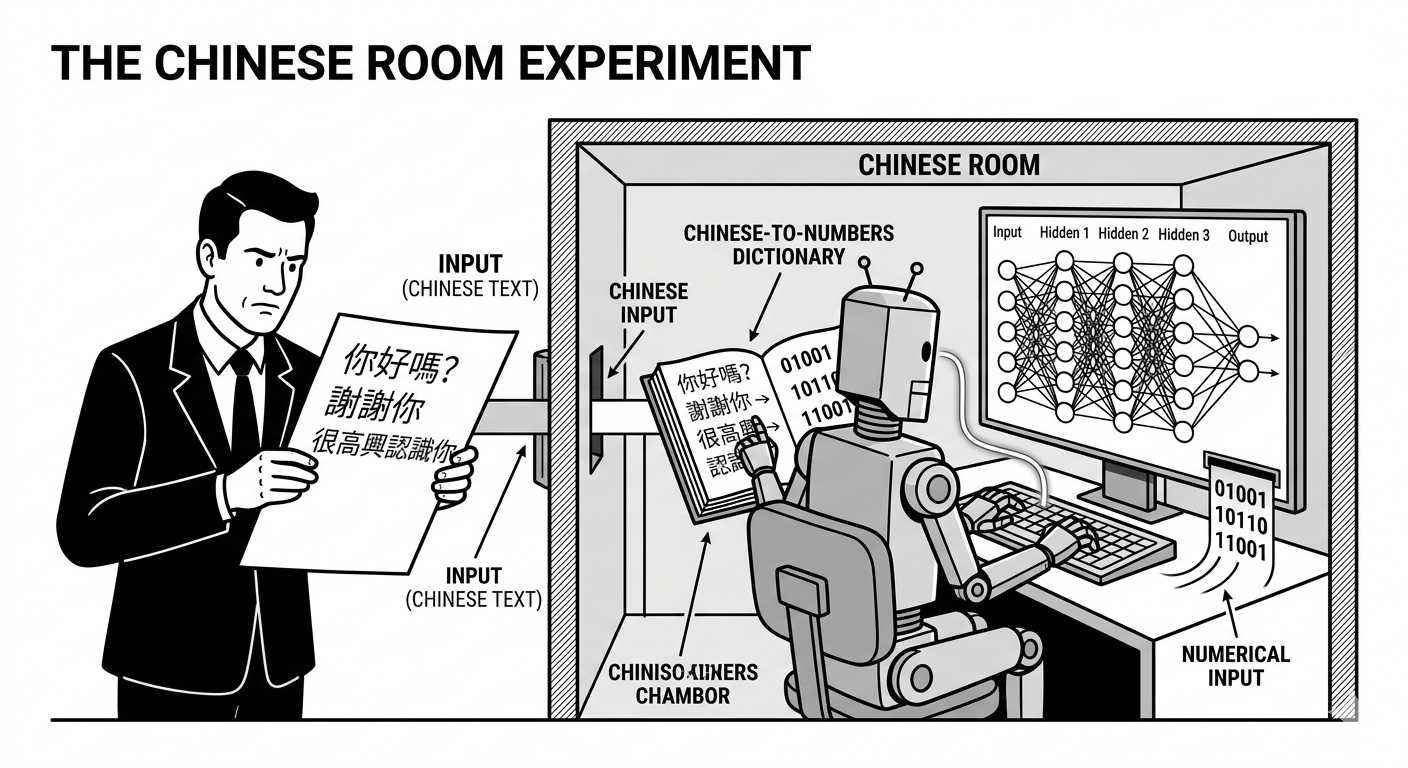
In domains such as contract processing — trade settlement being one example — there is no room for vagueness: every detail must be predictable and exact. For this reason, LLMs are not well suited to operationally drive such domains (for they are models of language not a models of a specific domain).
While LLMs can rapidly generate large amounts of programming language code, the domain itself is no longer represented explicitly. Instead, additional layers of encoding and decoding are introduced. Because these layers are themselves generated through probabilistic processes, they also introduce vagueness, unpredictability, and gradual deterioration over time.
Almost everything a financial institution does in digital form can be expressed directly in DCM at the conceptual level, which is essentially a business-level description. As a result, there is nothing left to code in a programming language, whether manually or via LLMs, nor any need to tailor large legacy packaged applications.
Technical artefacts—such as programming language code, services, messages, databases, and schemas—become products of inference that are materialized only when needed. They are automated out of the process of building and evolving the IT systems that run the business.
Unlike “AI” code generators, the output of DCM is not programming-language code but world models expressed in cognitive logic.
Almost all processing happens at this conceptual level, without degrading into the technical level, where too much valuable information is lost in translation. Yet these conceptual models run like regular software and can interface with the lower technical level when required.
Unlike ANN/LLMs, these models are deterministic, reliable, predictable, and directly interpretable by humans because they follow the same common-sense logic as human cognition—albeit in a formal form that can run on a computer.
Unlike traditional symbolic “reasoning” systems rooted in computation, DCM is cognitive in nature: it is grounded in guiding the actions of an agent embedded in space and time, not in detached abstract symbol manipulation for theorem proving.
LLMs are very effective for generating initial outputs, but they tend to accumulate noise and inconsistencies as the system evolves. Due to the indirect and opaque nature of generation, they do not scale cleanly with time or system size. Explanations for generated behavior are themselves generated after the fact and do not expose a true causal chain behind previous outputs, because LLMs do not operate on explicit world models.
The DCM approach scales over time and with system complexity because it does not accumulate noise or drift with each modification. This comes from its direct mapping to the business domain. A DCM description turns a system into a fully transparent “white-box” with human-readable reasoning. It can always answer why at every level, thus connecting low-level behavior to high-level business objectives.
DCM approach
DCM starts from the opposite pole—from the business goals, not the technical means—seeking to correct this upside-down model and put it back on its feet.
DCM tackles the problem at its root: it formalizes the business domain itself and makes it directly executable—turning business logic into running software, much like geometry transforms the equation of a circle into pixels on a screen, rather than manually drawing each pixel and relying on “best practices” to approximate a round shape.
With DCM, your business logic is the code. No vague “requirements.” No costly mistranslations. Just a directly executable model of your domain, built for transparency, speed, and adaptability.
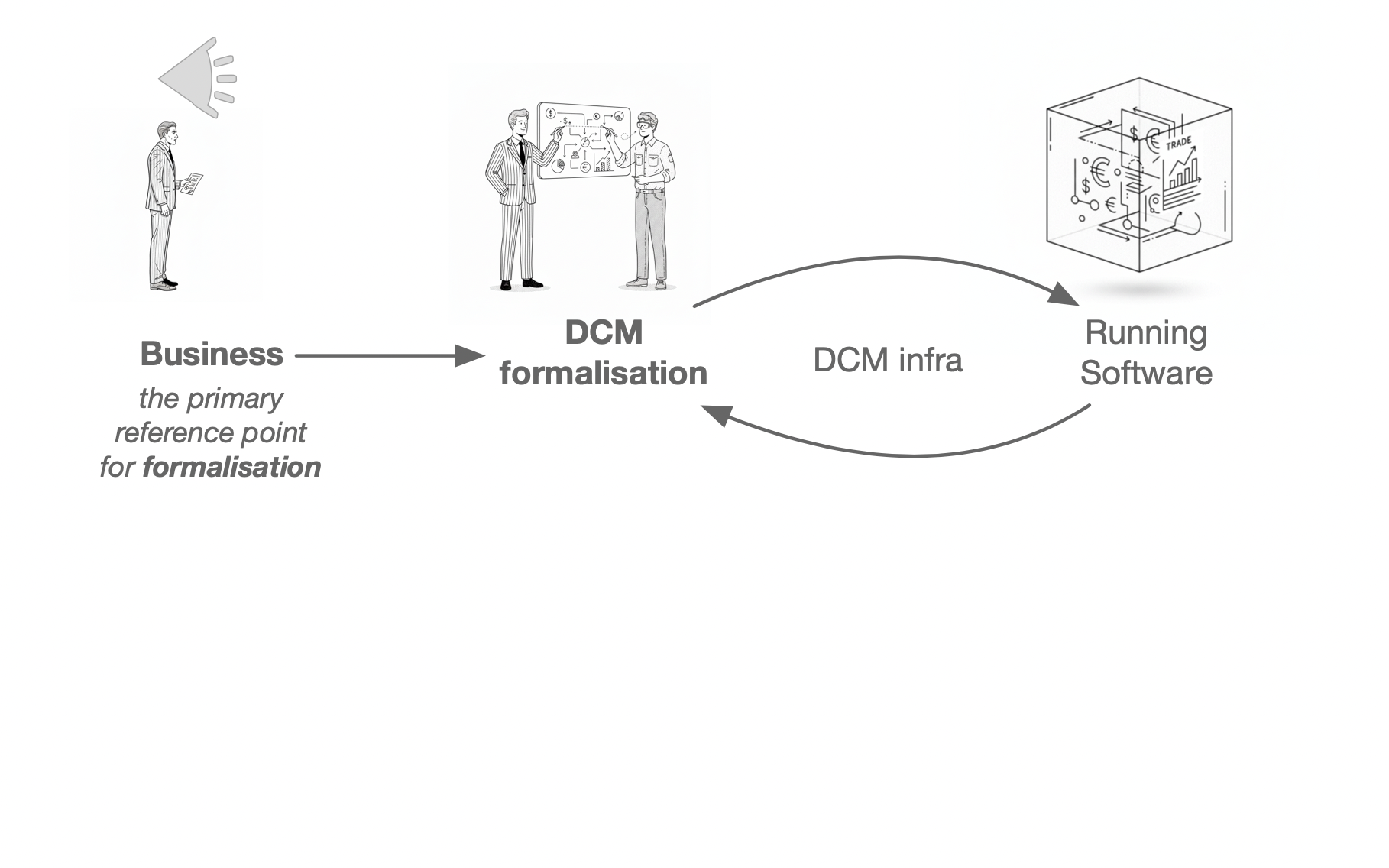

Programming languages and the frameworks built on top of them were never scientifically engineered to handle the complexities of human business domains—such as executing financial contracts. DCM, by contrast, is built from the ground up to meet this challenge, drawing on deep research in the sciences that study such domains, including cognitive and brain sciences, linguistics, perception, complex systems theory, and more.
DCM starts with goals and causes formulated independently of the technical level and can therefore leverage inferential machinery (i.e., common-sense logic) to derive technical effects automatically. Technical artefacts—such as event storage in databases or communication orchestrated via messaging systems—are generated automatically as effects of causes that are formalized at the business level.
Thus, it is the business floor that actually drives the IT system; that is the level of reality where the system is built. The technical floor is subordinate to the business floor by design—the actual construction happens mostly at the business level (at a conceptual level that corresponds very closely to the business itself).
The correspondence between the two floors can be enforced and traced both upward (decoding) and downward (encoding) automatically.
What job is it good for?

Contract Execution and Management
Examples of trade processing concepts that are directly expressible using existing constructs in DCM—almost entirely capturing their semantics—include:
transaction, option, custodian, nostro account, position ( settled, pending), settlement instruction, pre-advice, borrowing-landing, corporate action, reconciliation, netting, and more.
The only domain-specific element is the label. The underlying structure—and therefore the semantics—is general. This is being demonstrated in the examples where a domain-specific “nicknames” are given to more general, abstract configurations.
While trade processing is the target domain discussed here, DCM is equally applicable to any domain where contracts between multiple parties are central.
DCM focuses on business domains rooted in natural human activities—and as cognitive science over the last 50 years has shown, this list is far broader than it may seem at first glance.
By contrast, DCM is not applicable for purely technical domains such as image processing, data storage, or specialized niches like map navigation or threat detection in self-driving cars.
DCM is essentially a full-fledged formal theory of contracts as socio-cognitive constructs. Thus, the way DCM automates (digitalizes) contract execution mirrors the way a human understands it.
The main hypothesis of applying DCM is: once you remove all the general cognitive structure from the contract management domain, no structure remains unaccounted for. There is nothing left to ‘code‘ after formalising the domain within DCM.
DCM vs “Smart Contracts”
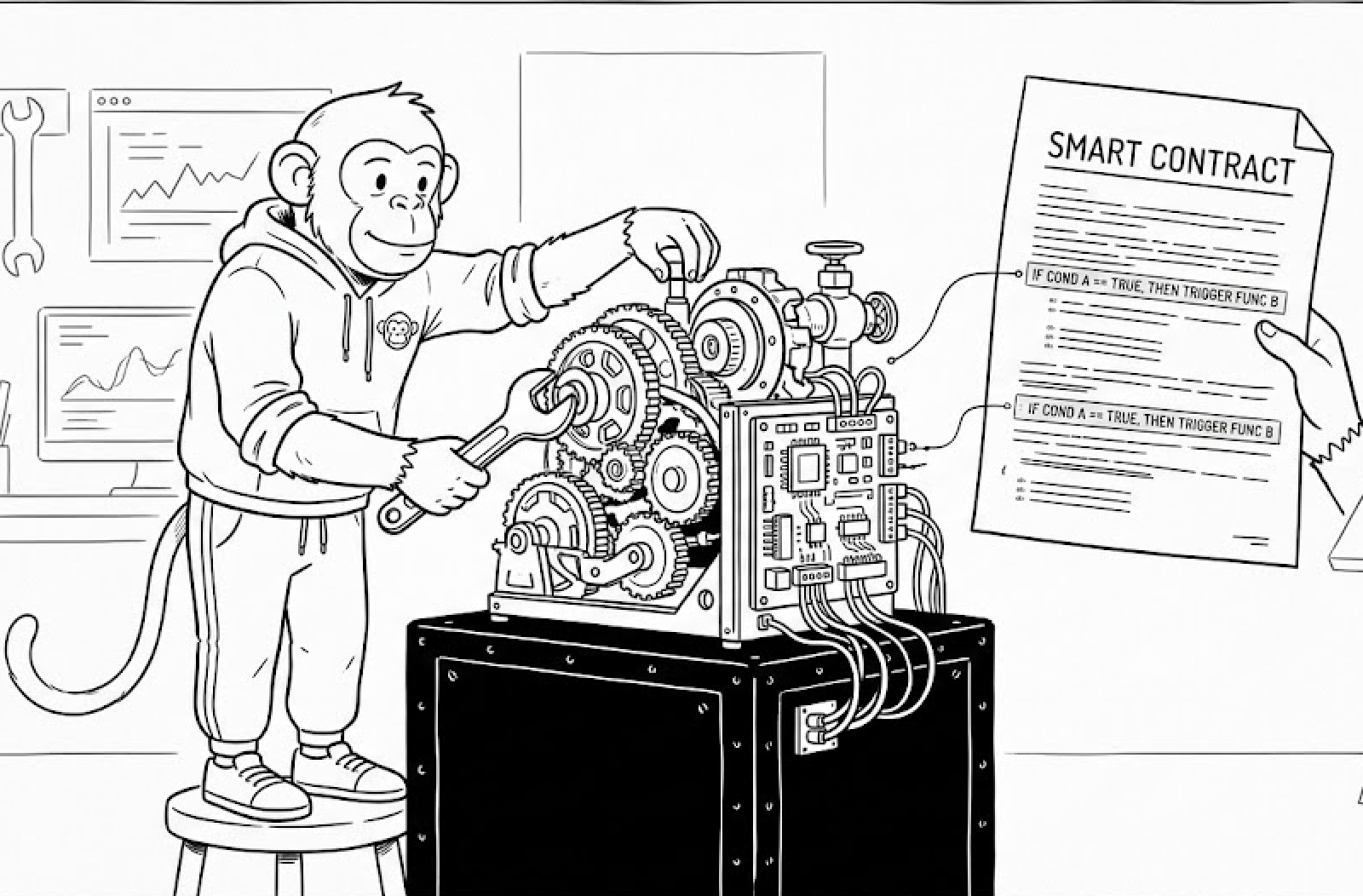
The fact that a DCM description of a contract is executable is what the phrase “smart contract” would truly mean to a person whose expectations had not already been lowered by the reality of what so-called “smart contracts” actually are.
What are commonly called “smart contracts” today are, in essence, just collections of programming-language code, no different in principle from the code used to display a social media feed. There is nothing inherently “smart” about them apart from the use of a blockchain. Attributing “self-execution” to a piece of computer code is essentially tautological, marketing slogans aside.
DCM, however, takes the notion of “self-execution” at face value. It captures the meaning of the contract within the very definition of the contract itself, requiring no additional code to be attached externally in order to animate it.
Furthermore, the fact that conventional “smart contracts” are manually implemented in general-purpose programming languages provides no inherent advantage when pursuing goals such as:
formal verification;
extremely low error tolerance;
risk-averse security;
These are often advertised as distinguishing strengths of the “smart contract” approach.
DCM, by contrast, starts from an entirely different foundation: not from a programming language, but from cognitive models. Within such a framework, all these goals can be achieved far more efficiently and with significantly less complexity.
None of the elements of DCM were specifically built for, or intended to exclusively serve, the financial domain.
The only domain-specific elements are the labels attached to the structures that DCM operates on. DCM is grounded in general concepts and theories from cognitive and brain sciences, which have no inherent knowledge of the trade processing domain.
Yet, elements that appear highly specific to trade processing are rendered directly within DCM—without requiring any additions or the introduction of domain-specific semantics. The core of DCM remains agnostic to the trade domain, yet is capable of expressing its concepts fully.
Concepts from trade processing that may seem unique or exclusive to that field map directly onto pre-existing building blocks within DCM. In other words, seemingly specific trade-related terms arise naturally within DCM, even though it was never designed specifically for them.
Why It Matters?
many FTEs for many months
few FTEs for a few days
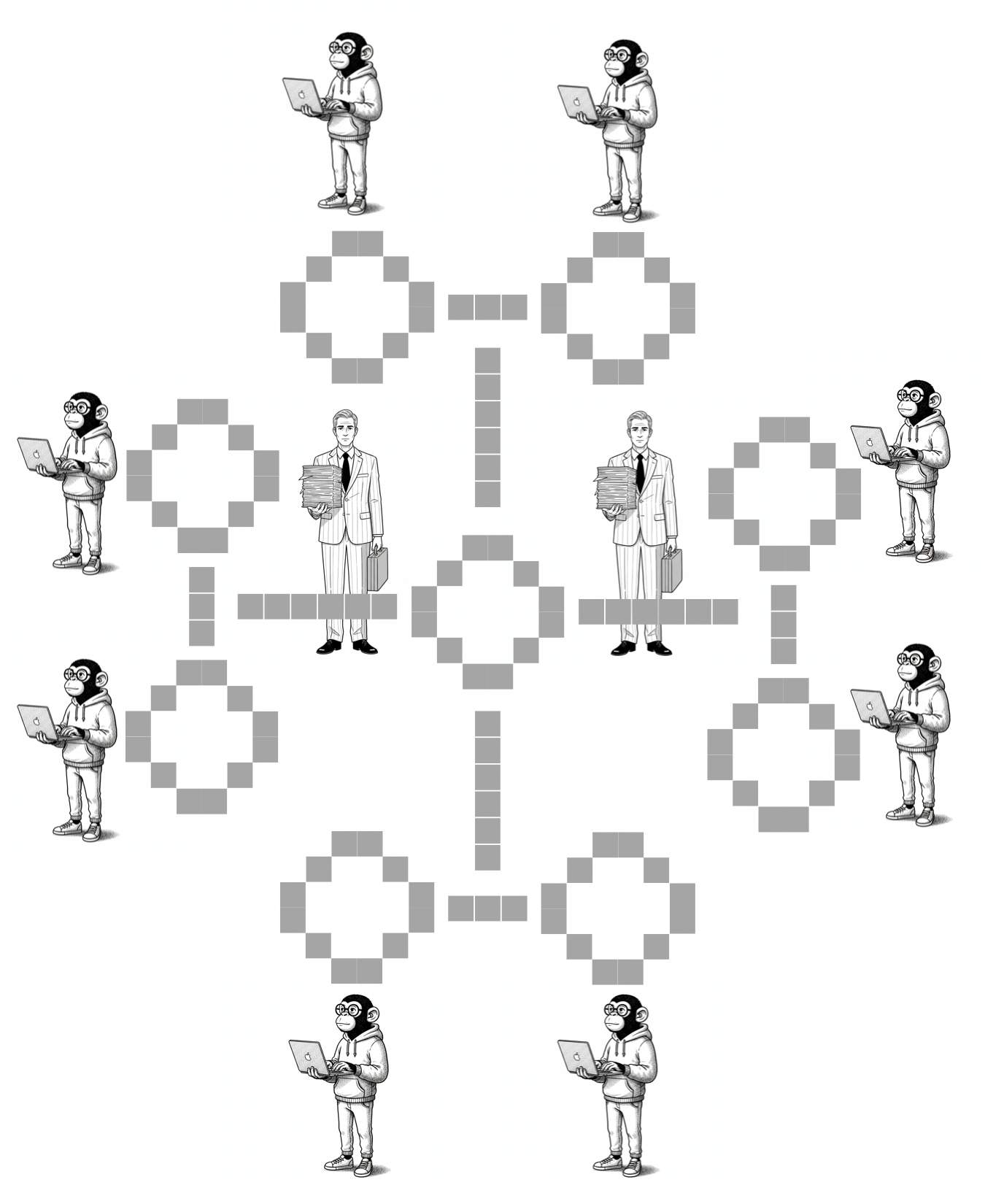
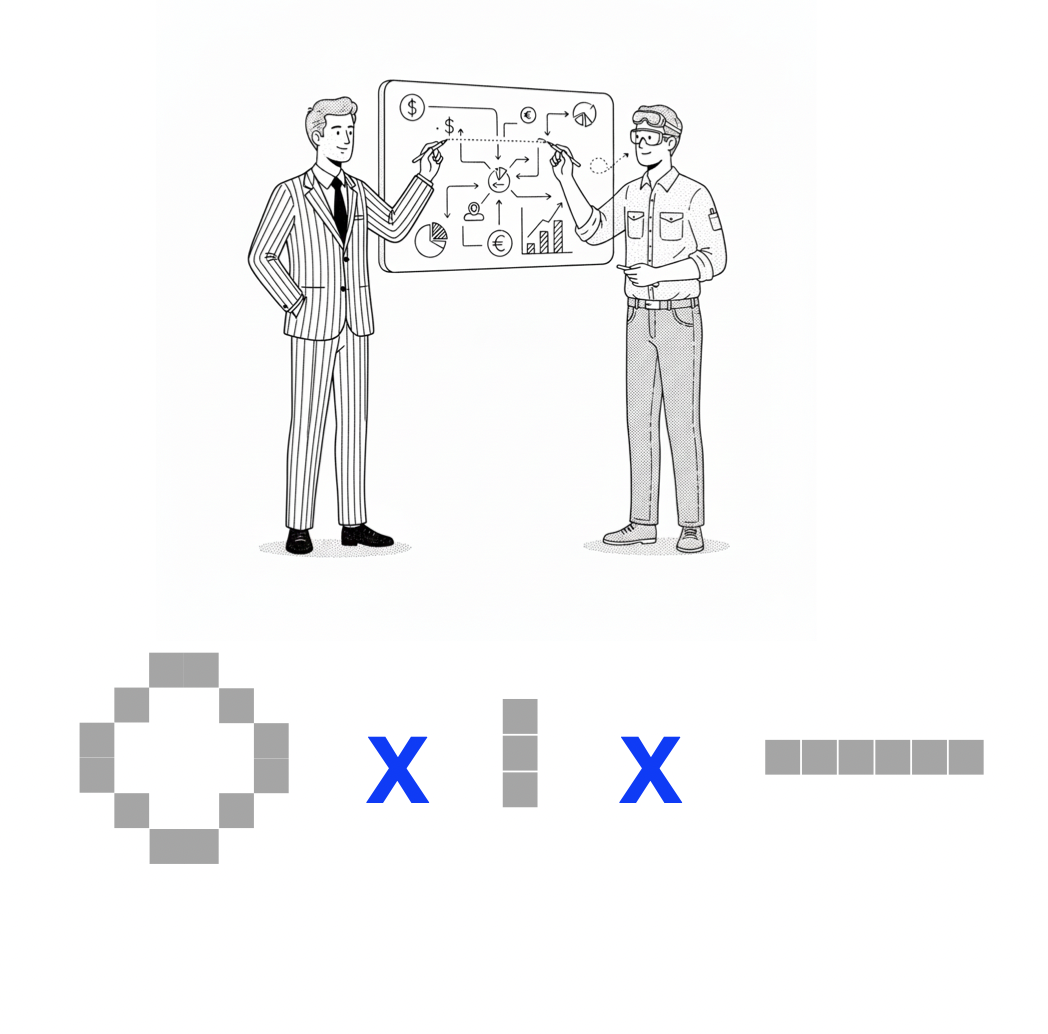
DCM enables complex changes and extensions to be made to already sophisticated systems in a matter of days by a few people —changes that would typically take months or even years for large teams of developers to implement using conventional methods.
Equally important, it offers a level of reliability and security that is practically unachievable with traditional approaches.
This comes at a cost: it requires adopting a new foundation, a new basement. However, it integrates seamlessly with traditional systems, making it possible to blend legacy IT systems with the new architecture.
The benefits of this method easily overweight the costs for mid-to-large-scale systems that are expected to operate for years and are mission-critical, demanding high levels of stability and correctness. This method is not intended for small, trivial systems with minimal business logic or low operational importance, where traditional coding methods work just fine.
There’s no need to descend to the technical level (no coding), and no need to fill in every detail at the business level either (no repetitive or redundant requirements). Simply describe the contracts you want to have in their minimal form. Everything else will be inferred automatically by DCM in a deterministic manner, and you can always ask why something happens or how something is implemented and get a meaningful answer.
Key distinguishing features
Semantic Transparency
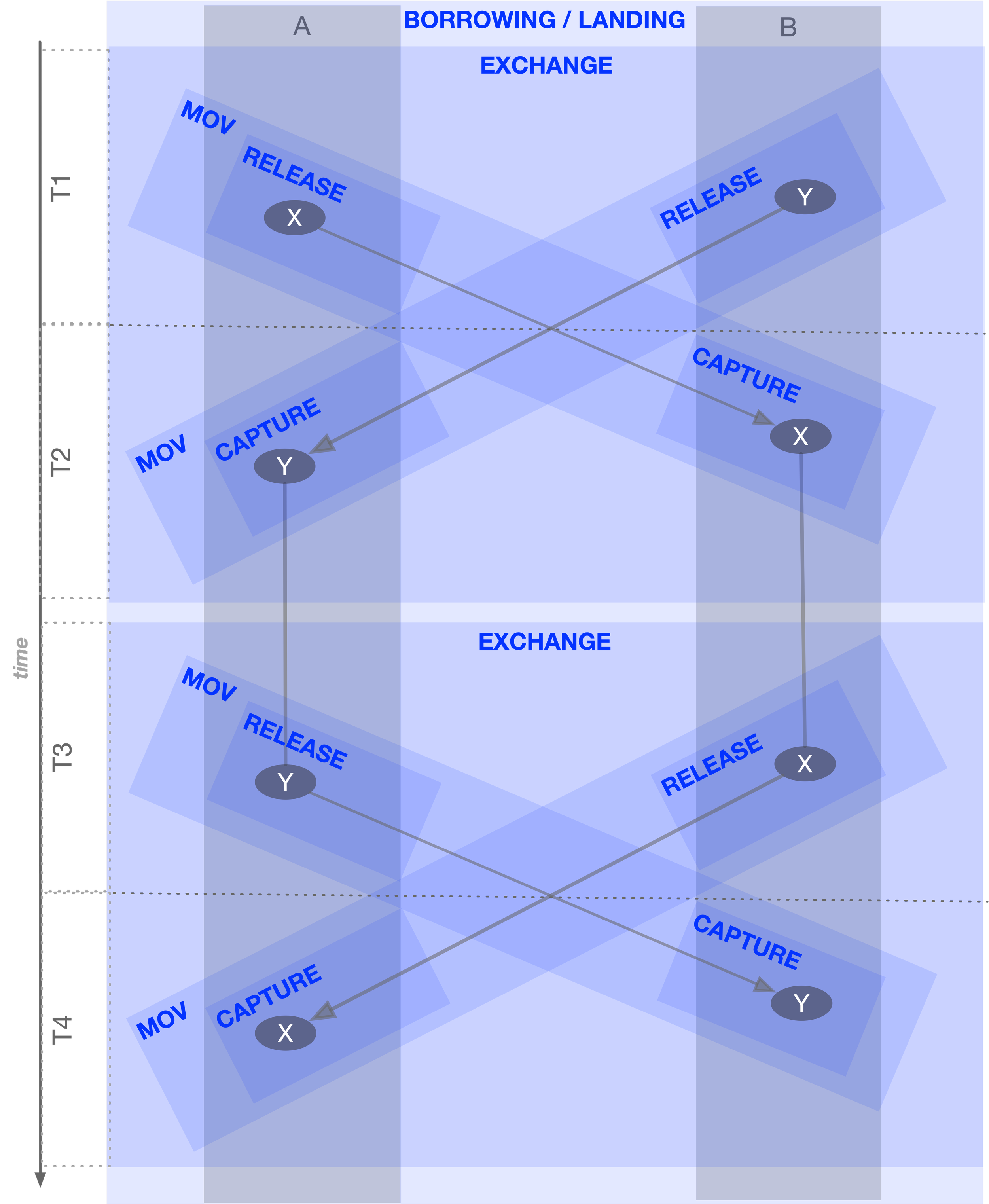
At the heart of DCM lies the principle of semantic transparency: what you see is what you get. The structures you see in DCM are the actual structures of the business domain itself—not just technical constructs or intermediaries. This ensures that, when building with DCM, the business domain remains directly visible and transparent, both in the code and in the running software.
In DCM, meaning resides in the structures themselves.
By contrast, in traditional programming languages meaning is imposed externally and only made visible through naming conventions when attaching labels to technical elements.
Traditional code has a shallow dispositional semantics: it operates through accidental correlations rather than intrinsic structure.
Human Scaling

Traditional software is designed around the constraints of computer hardware, not the capacities and limitations of the human mind. As a result, technical solutions often become so complex that people struggle to keep an efficient grasp—whether in understanding what the system is actually doing or in making changes to implement new business features.
DCM takes the opposite approach: it employs mechanisms modeled on how human cognition (reasoning) work, grounded in decades of research in cognitive linguistics and brain sciences.
This preserves a human scale even within large and sophisticated software systems—keeping them easy to change and extend, and avoiding the trap of software losing its malleability as code size increases.
Perspectivity
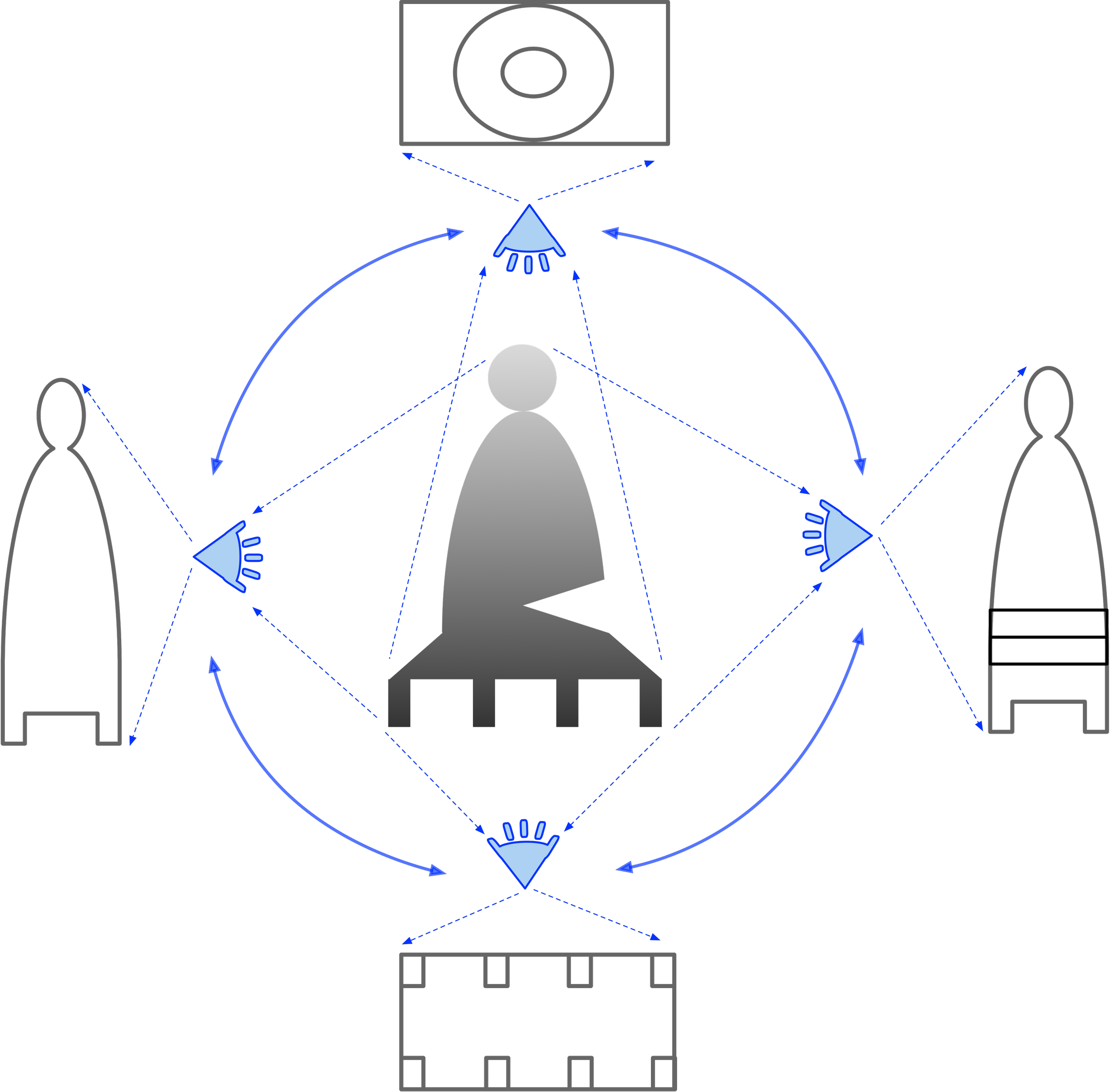
DCM lets you overlay multiple perspectives on the same content.
The system ensures that these different views are complementary and non-contradictory, enabling the multidimensional whole to be automatically reconstructed from multiple projections—without requiring you to confront the full complexity of that whole directly.
This preserves human-scale reasoning.
Thus, DCM employs the so-called collage mode of composition, which allows overlap between parts.
Traditional programming languages, by contrast, are built on a Lego-block model of composition, which implies exclusivity of representation.
As a result, there cannot be multiple complementary projections: there are no cross-cutting hierarchies, only a single exclusive hierarchy that must capture all the variety of the content.
Agency
action guidance as raison d’être
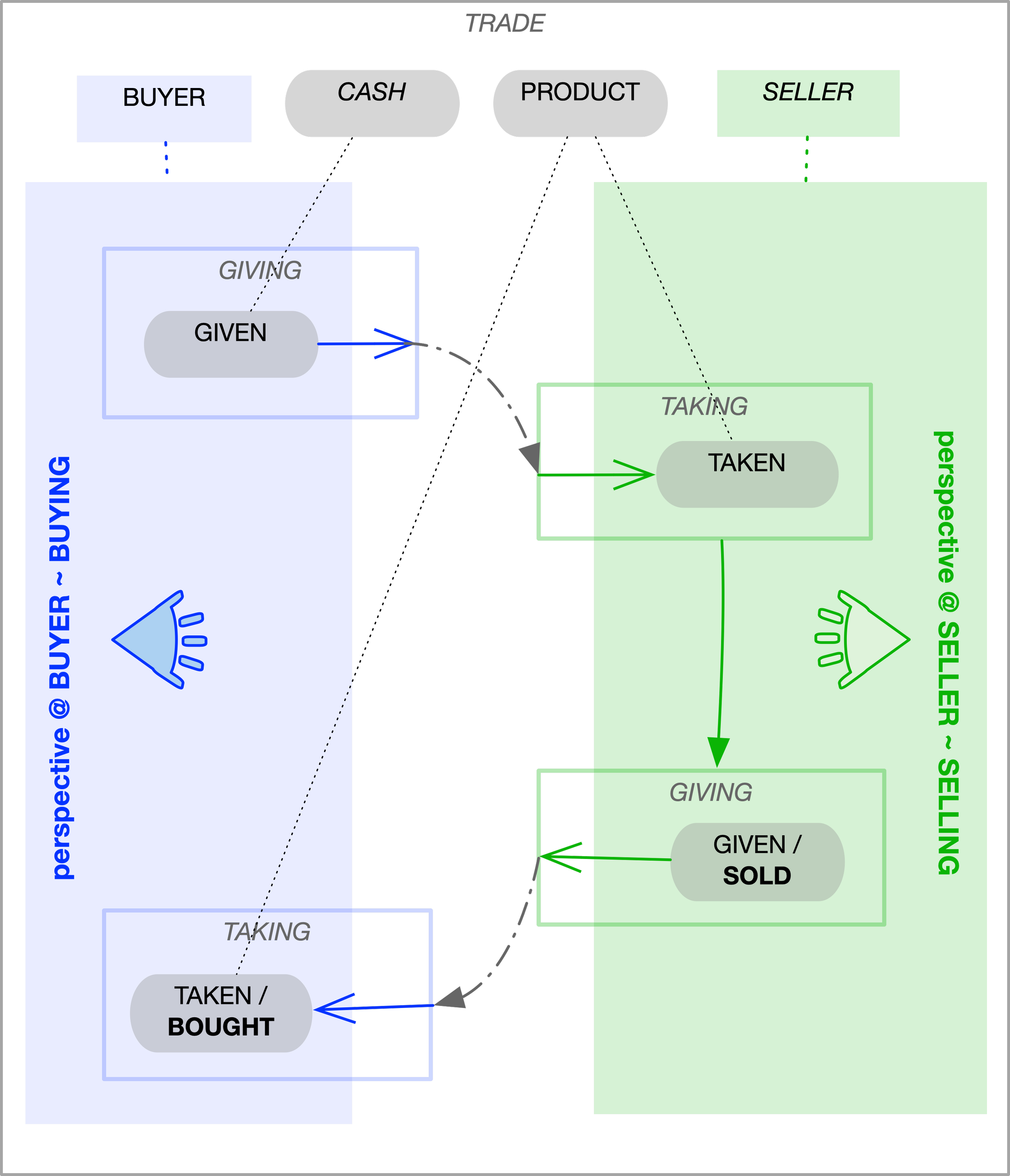
DCM is based on a model of intersubjectivity that combines two notions of space: the subjective space of agents (e.g., parties to a contract, each having their own perspective) and an objective space representing the shared world. This objective space acts like a map in which each agent can step outside their own ego-centered perspective and understand the points of view of other agents.
Contrary to DCM, the traditional approach does not even recognise agency as such; there is no notion of dynamics, interaction, or an explicit temporal dimension in the implementation domain. There are only arrangements of memory cells whose values are numbers or characters.
This simply reflects the fact that programming languages are not really languages, but dressed-up instructions for computers originally designed for number crunching.
Generating Kernel
Following the natural path to build systems
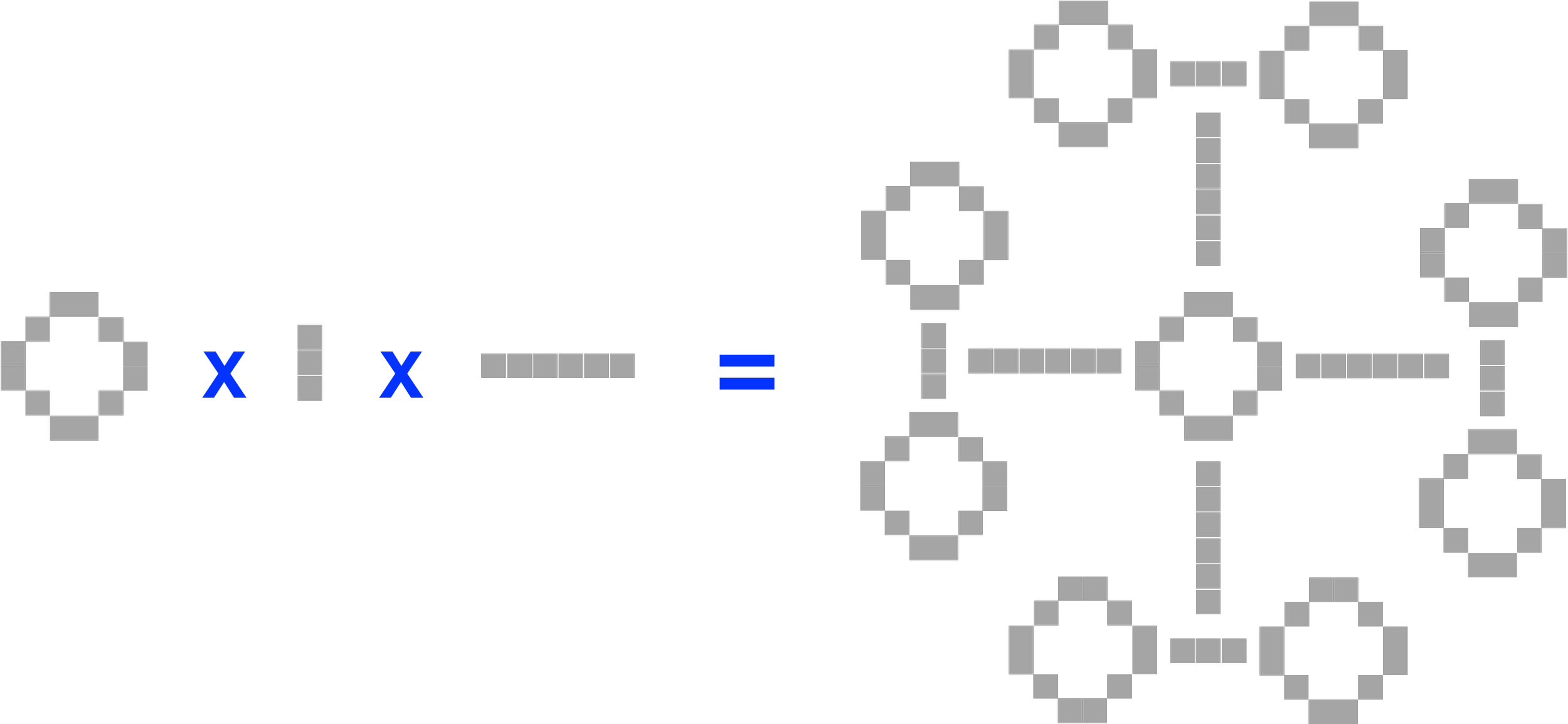
The way to build with DCM is first to understand how something comes into being—what processes cause the appearance of a particular structural element, not just what the element is on its own, detached from the process that generated it.
It is like building a tree: follows the same way to build a tree as nature does : grow it from the seed.
If a different tree is required, the DCM approach would involve changing the seed or intervening in the growth process at the right moment—for example, by placing a barrier to limit the tree’s width or height.
Contrary to DCM, the traditional approach is to build an already gown up tree, simply by adding elements together.
This method does not reflect the tree’s morphology; the relationships between branches and leaves are lost. All elements are treated as equal, being given in their current shape and “appearing all at once” or as “pre-existing.”
This is inefficient as this method can not rely on the automatic replication of structure along the growth path (of change of the seed changes all the leaves in a tree) that the DCM approach is based on.
Modelling Relation
The formal relation between business and software
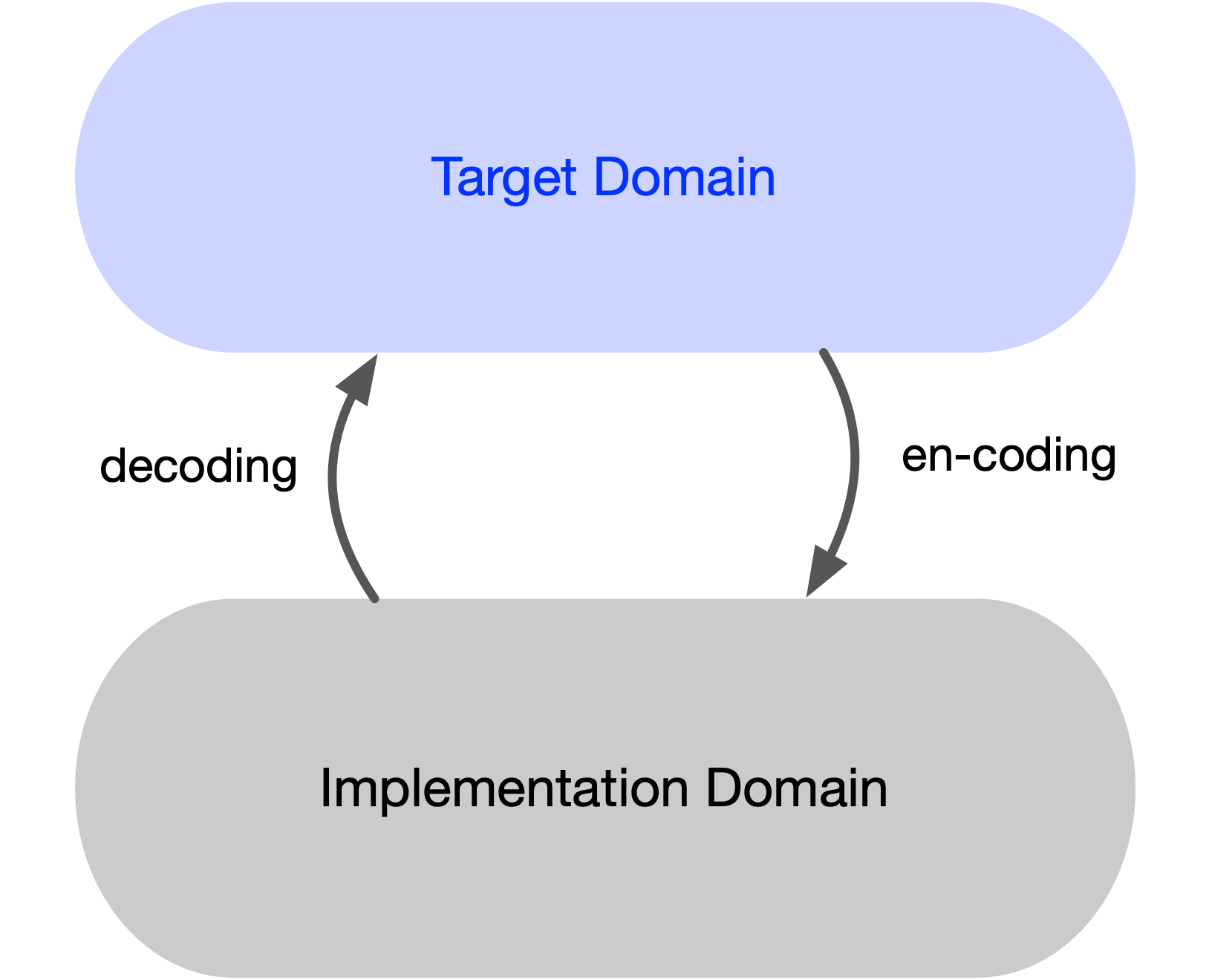
The way that DCM looks at the task of building a software system that runs a business is similar to how a biologist builds a model for a living organism.
It starts by acknowledging that solving this task involves two different domains, not just the task itself: the software domain and the business domain.
DCM then follows a formal framework that aims at establishing a specific relation between these two—the modelling relation—which ensures that the software is a model of the business and not just a superficial imitation.
Contrary to DCM, the traditional approach does not acknowledge the existence of the business domain as such; hence, the business domain manifests itself only informally as vague software requirements, lacking formal structure.
Another problem is that the business domain is treated as an afterthought, in the sense that it does not serve as a fundamental factor shaping the technical domain.
Rather, the business domain appears as a post-factum application of the technical domain (hence the term “business application”), where the latter was created prior to and without an understanding of the former.
How it works
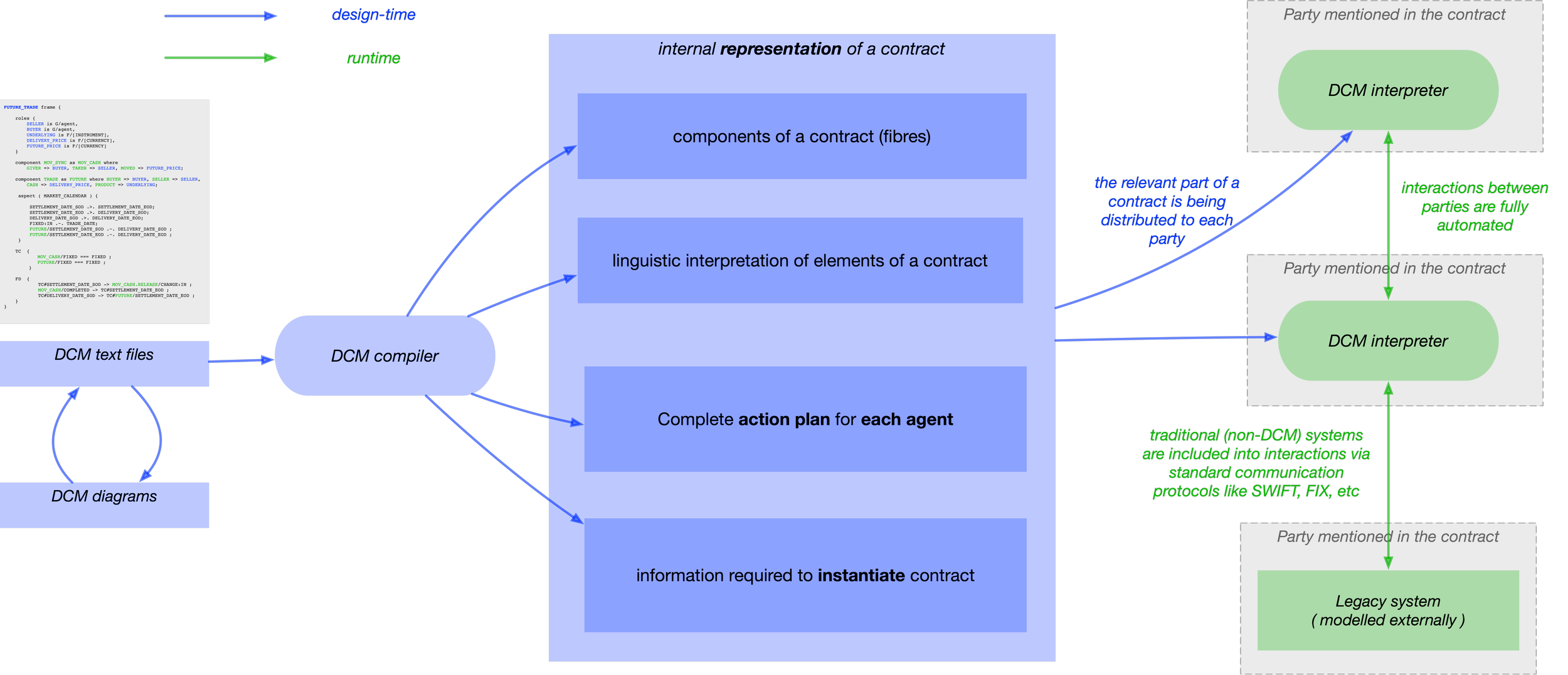
To implement a software system that executes a contract using DCM, the following steps are followed:
1. Write a formal description of the contract—either as text files in the DCM format or as diagrams. These artifacts represent the “source code” of the contract.
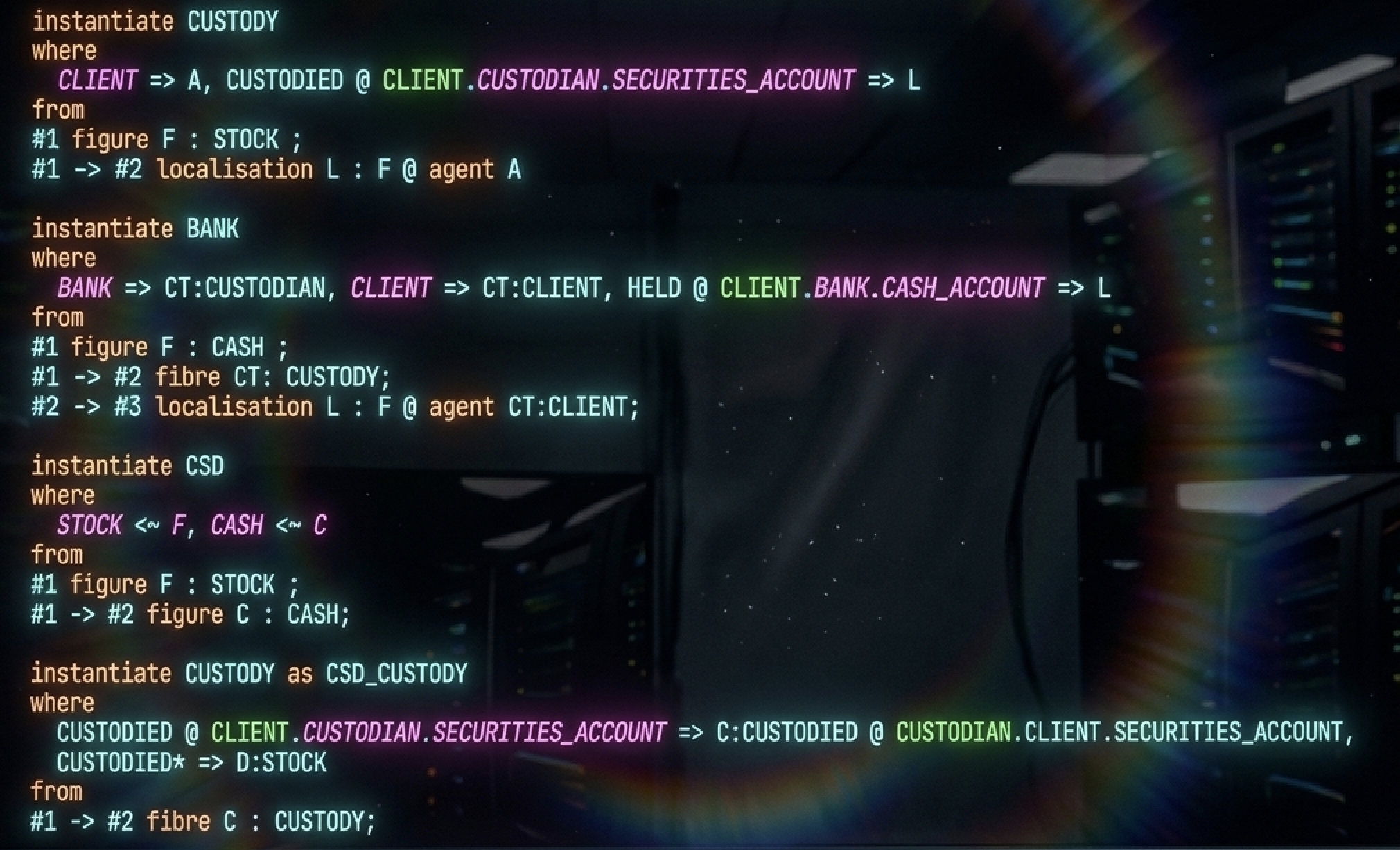
The core mechanism for building structures in DCM is the notion of a frame and layering frames over one another, like elements in a collage. For example, to build a system that executes a TRADE settlement, a TRADE frame is constructed from more primitive frames and then contextualized with other frames, such as CUSTODY. The resulting construction is called a construal (a term borrowed from cognitive linguistics).
2. Feed these artifacts into the DCM compiler, which performs extensive inference and generates an internal representation of the contract. This includes all information required to instantiate a new contract, as well as a complete action plan for each party involved—defining what each party must do to fulfill its role. This step succeeds only if the contract description is consistent and executable. If the description is incomplete or contains conflicting actions, it will fail to compile. In essence, this step allows DCM to “fill in the gaps” in the description, much like how the meaning of a sentence is constructed from just a few grammatical and lexical cues.
3. Each party receives the relevant portion of the contract, including a script for playing its role. In real-world scenarios, any contract typically depends on the existence of other contracts, each involving only a subset of participants from the main contract. For example, in a TRADE contract, the BUYER may have a CUSTODY contract set up with its CUSTODIAN, which the SELLER does not need to know about, since it is not a participant in that custody agreement. As a result, each party ends up with its own relevant set of contracts that define its role—what it must “perform on stage.”
4.Non-DCM systems can participate in contract execution via existing communication protocols such as SWIFT or FIX. A mapping must exist between these protocols and the DCM system. For instance, a DCM system communicating with a traditional system via SWIFT will interpret the content of SWIFT messages in DCM terms, and vice versa. In the TRADE example, certain actions in DCM correspond directly to settlement instructions and pre-advice SWIFT messages—so DCM actions of the info pane can be mapped one-to-one with such protocol messages.
Note that any real-world system will include many interlinked contracts, meaning that a given party’s action script is compiled as a superposition of multiple contracts.
Why D.C.M. ?
D stands for “Deep”, because CM models capture causal relationships within the content they represent. This enables rich inferential chains, allowing the system to generate content automatically that would otherwise need to be built (coded) manually.
C stands for “Cognitive” (or Conceptual), reflecting the fact that the approach is grounded in cognitive science and the scientific study of conceptualization—in other words, how thinking and understanding works.
M stands for “Models”, because these formal representations are intended to serve as models of the target domain, standing in a formal modeling relation to that domain.
Find out more
Investigate the difference between DCM, programming languages and AI/LLMs
Example of using DCM to formalise the notions of future and option
See how DCM can be applied to implement the settlement of a trade using just a few pages of conceptual description.
An introduction to a theory that DCM is built upon including frames, vantages, modelling relation and more
Follow the DCM story from the beginning, starting with the foundational question that arises when building large software systems that run a business.